
Artificial intelligence is everywhere in B2B marketing these days—powering chatbots that capture leads, generating personalized content at scale, scoring prospects, and even helping sales teams prioritize outreach. But two terms keep coming up that often get mixed up: training and inference.
If you’ve ever wondered what happens when you type a prompt into ChatGPT, Claude, or Grok—or why some AI tools feel “smart” in the moment while others require heavy setup—this distinction is the key. Understanding the difference helps you choose the right tools, control costs, protect customer data, and get better results from AI in your demand-generation programs.
What Is AI Training?
Training is the learning phase. This is when an AI model studies massive amounts of data and adjusts its internal parameters (often called weights) so it can recognize patterns and make better predictions.
Think of it like a new hire studying every product sheet, case study, competitor analysis, and customer conversation your company has ever produced. During training, the model:
- Processes huge datasets
- Calculates errors through a loss function
- Uses optimizers to update its parameters
- Repeats this process thousands or millions of times
For large language models (LLMs), this phase is extremely expensive and time-consuming. It can take weeks or months on specialized hardware and cost millions of dollars for frontier models. Once training (or fine-tuning) is complete, the model’s knowledge is essentially locked in.
Critical point for marketers: If you feed customer data directly into an LLM for training or fine-tuning, that data becomes part of the model’s permanent knowledge. The model can potentially memorize and later reproduce pieces of it. This creates real privacy, security, and compliance risks (GDPR, CCPA, industry regulations, customer contracts). Once data is baked into the weights, it is extremely difficult—and sometimes impossible—to fully “unlearn.”
What Is AI Inference?
Inference is the application phase—the moment the trained model actually does useful work. You give it new input (a prompt, a website visitor’s behavior, a product description), and it generates an output using the knowledge it already has.
Every time you:
- Ask an LLM to write a personalized email sequence
- Have a chatbot qualify a website visitor
- Generate product comparison content
- Score a lead in real time
…you are running inference.
During inference the model’s parameters stay fixed. There is no learning happening. It simply performs a forward pass through its neural network—predicting the next token one step at a time until the response is complete.
Most AI apps and enterprise LLM platforms operate in inference-only mode by default. Customer data is used temporarily as context for that specific request. It does not update the underlying model. When the session ends (or according to the provider’s retention policy), the data is not retained for training. This is far safer for privacy and compliance.
Inference is not a “search function.” Search or retrieval (like pulling documents for RAG—Retrieval-Augmented Generation) can feed information into the model for a single response, but the actual generation of the answer is still inference—and the model itself remains unchanged.
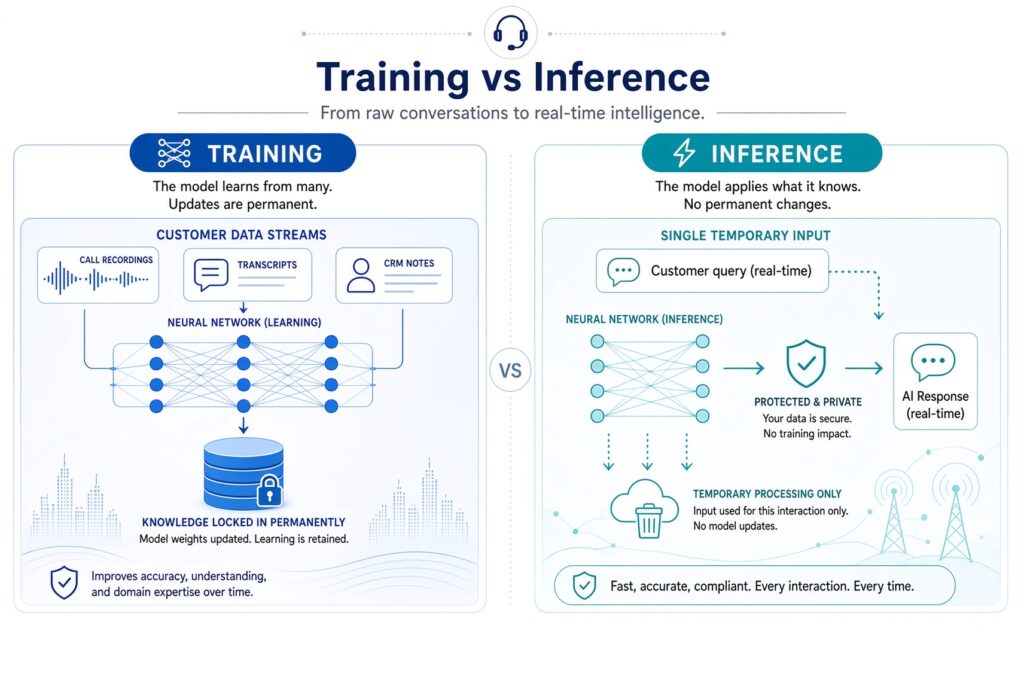
Training vs. Inference: Side-by-Side Comparison
| Aspect | Training (or Fine-Tuning) | Inference-Only (Most AI Apps) |
| Purpose | Teach or specialize the model | Apply the already-trained model to new inputs |
| What happens to weights | Weights are updated | Weights stay fixed |
| Customer data impact | Data can become permanently embedded in the model | Data is used only for the current response |
| Privacy & compliance risk | High – potential memorization and leakage | Much lower – data does not alter the model |
| Speed | Slow (hours to months) | Fast (seconds) |
| Cost | High | Relatively low per use |
| When it occurs | Offline / planned updates | Real-time, every user interaction |
| B2B marketing example | Fine-tuning a model on your closed-won deals and support tickets | Using ChatGPT Enterprise or a marketing AI tool to draft an email from a CRM record (without training) |
Why This Distinction Matters for Marketers — Especially Around Customer Data
Most of the AI tools marketers use every day—ChatGPT (with data controls on), Jasper, custom agents, or enterprise platforms—are running inference. You’re not training a new model with every prompt; you’re leveraging one that has already been trained.
This has major practical implications:
- Data exposure risk: Uploading customer emails, call transcripts, or CRM records to train or fine-tune a model means that information can influence future outputs for anyone using that model. Even with private fine-tuning, residual memorization risk remains.
- Inference-only safety: Reputable AI apps that clearly state they do not use your data for training keep customer information out of the model’s permanent knowledge. You get the benefit of powerful generation without permanently “teaching” the AI your proprietary or sensitive data.
- Cost and control: Inference is relatively inexpensive and reversible. Training or fine-tuning is expensive, requires expertise, and creates a specialized model you must manage going forward.
- When training still makes sense: Only when you have clean, authorized, non-sensitive data (or heavily anonymized data) and a clear need for deep specialization that prompting + RAG cannot deliver. For the vast majority of marketing use cases, inference + good context is enough—and far safer.
Understanding the difference also helps when evaluating vendors. Ask directly: “Does this platform use our prompts or uploaded data to train or improve the underlying model?” The answer should be a clear “No” for most marketing applications.
How to Put Inference to Work Safely in Your
Marketing
- Lead qualification and chatbots – Use inference-powered conversational AI that processes visitor data only for the current conversation.
- Content generation at scale – Generate first drafts from approved templates or non-sensitive inputs.
- Personalization – Feed account insights into an LLM via temporary context or RAG rather than permanent training.
- Research and summarization – Quickly synthesize public or approved internal documents without embedding them into the model.
For most marketing teams, the highest ROI—and lowest risk—comes from mastering inference (prompting, retrieval, and tool use) rather than feeding customer data into training pipelines.
Final Thoughts
Training creates the intelligence. Inference puts that intelligence to work for your buyers and your pipeline—without permanently altering the model with your customer data.
In today’s regulatory and trust environment, Marketers who clearly understand this distinction can select tools more wisely, protect customer information, set realistic expectations with legal and security teams, and move faster than competitors still treating every AI interaction as a mysterious black box.
Need help weaving AI—whether inference-focused tools or carefully governed advanced approaches—into your demand generation strategy while keeping customer data safe? Send us an email or visit towncriergroup.com to start the conversation.

![B2B Leads: How Many Do You Need? [Here’s How to Find Out]](https://towncriergroup.com/wp-content/uploads/2021/03/entry-conversion-exit-shutterstock_539917381-scaled-500x383.jpg)